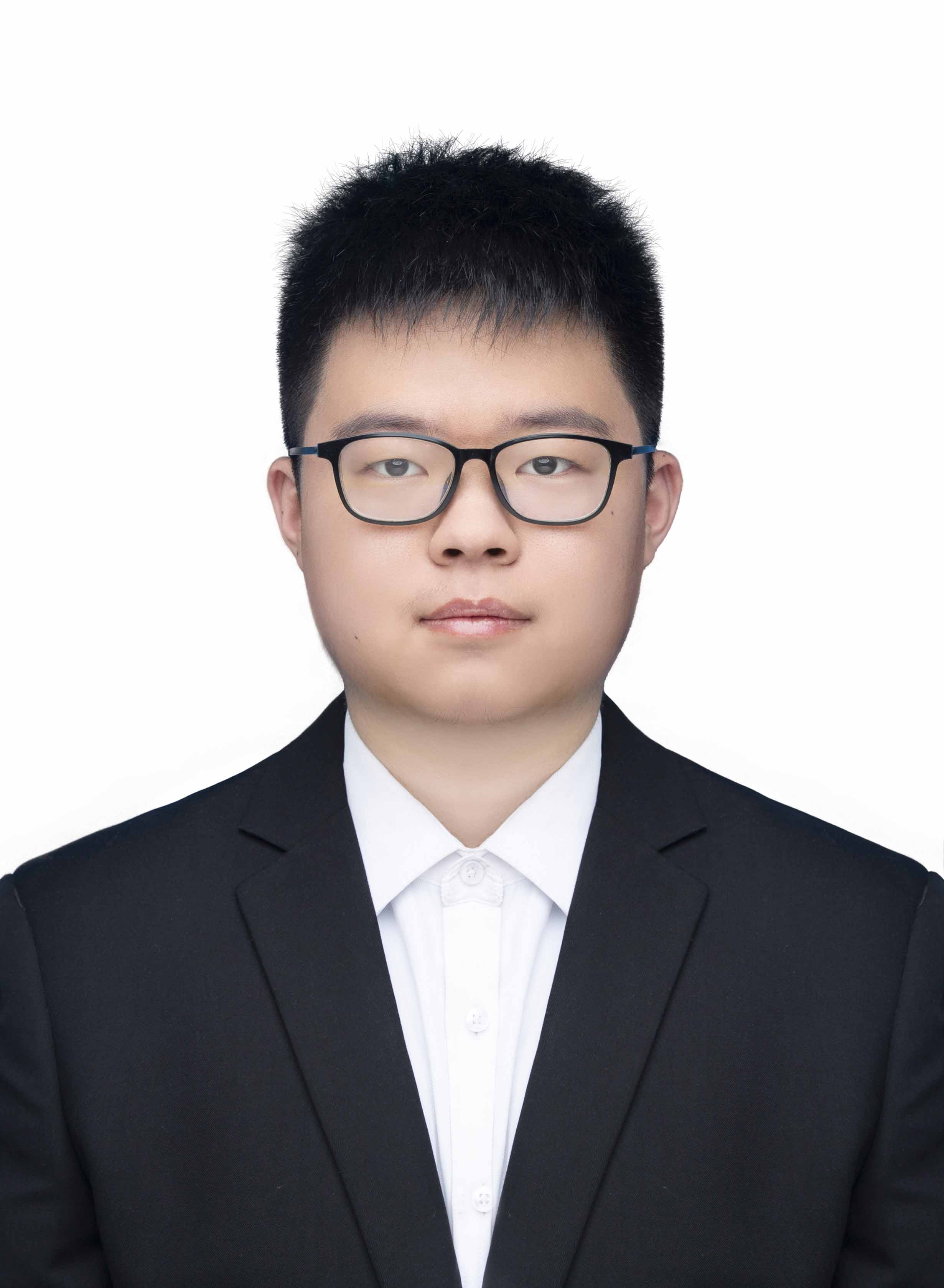
About Me
I am actively looking for PhD opportunities for 2027.
I am currently a Research Assistant at Southeast University, advised by Prof. Yiwei Wang and Prof. Yujun Cai. Prior to this, I was a Research Assistant at the AGI Lab, Westlake University, advised by Prof. Chi Zhang, and a Remote Research Intern at the NLP Lab, University of California, Merced. I received my B.Eng. degree in Artificial Intelligence from Hebei University of Technology.
My research interests focus on Multimodal dLLMs/LLMs, Post-Training of dLLM/LLM, and dLLM/LLM Agent Systems.
Publications
-
AURA: Auditory Spatial Intelligence via a Unified Representation from a General-Audio Encoder through Complete AlignmentSubmitted to TPAMI
-
ManimAgent: Self-Evolving Multimodal Agents for Visual EducationEMNLP 2026 (Main)
Education

Hebei University of Technology
B.Eng. in Artificial Intelligence
Sep 2020 – Jun 2024
Experience

Southeast University
Research Assistant
Advisors: Prof. Yiwei Wang, Prof. Yujun Cai
May 2026 – Present


NLP Lab, University of California, Merced
Remote Research Intern
Advisor: Prof. Yiwei Wang
May 2025 – May 2026
Research Projects
AURA: Auditory Spatial Intelligence via a Unified Representation from a General-Audio Encoder through Complete Alignment
Lead Project Member · Jun 2026 – Present
Advisors: Prof. Yiwei Wang
- Developed AURA, an auditory spatial intelligence framework that builds a unified representation from a general-audio encoder to achieve complete audio–text alignment.
- Introduced complete-alignment supervision to unify audio and textual modalities, resolving the representation gap that limits auditory spatial reasoning.
- Achieved competitive spatial reasoning with approximately 40% of the trainable parameters of specialized baselines and strong zero-shot generalization to general audio tasks. Submitted to TPAMI.
ManimAgent: Self-Evolving Multimodal Agents for Visual Education
Contributing Member · Apr 2026 – Jun 2026
- Co-developed ManimAgent, a self-evolving multimodal agent that generates Manim animation code from scientific paper sections via VLM-guided reflection.
- Built a dual-channel episodic memory bank — positive success rationales and negative failure patterns — populated entirely from the agent's own task stream, with no weight updates and no human seeds.
- Improved first-attempt animation generation success from 68.5% to 84.9% and reduced average reflection rounds from 12.2 to 6.5. Published at EMNLP 2026 (Main).
Training-Free Format Control for Large Diffusion Language Models
Independent Researcher · Jun 2025 – Oct 2025
Advisors: Prof. Chi Zhang, Prof. Yiwei Wang
- Implemented a training-free inference algorithm for large diffusion language models, utilizing token-level softmax scores to guide dynamic anchor selection, ensuring robust structural integrity across diverse scenarios in zero-shot settings.
- Conducted rigorous evaluations on mathematical reasoning (GSM8K, MATH) and JSON benchmarks against Dream-7B and static infilling baselines.
- Significantly enhanced format adherence while preserving reasoning accuracy: achieved over 70% format retention in mathematical reasoning and maintained a stable ~80% valid JSON generation rate across various extraction methods.
Hard to Read, Easy to Jailbreak: Visual Degradation vs. MLLM Safety Alignment
Core Contributor · Oct 2025 – Feb 2026
Advisors: Prof. Yiwei Wang, Prof. Chi Zhang
- Identified a visual-degradation-induced jailbreak vulnerability in multimodal LLMs, where lowering image resolution inadvertently bypasses safety alignment even when the text remains legible.
- Characterized the underlying "Cognitive Overload" mechanism, showing that decoding degraded input (low resolution, noise, geometric distortion) diverts model attention away from safety auditing.
- Proposed a Structured Cognitive Offloading defense that serializes visual transcription and safety assessment, significantly reducing jailbreak success rates while preserving visual text recognition accuracy. Published at ACL 2026 (Findings).
SQLAgent: Learning to Explore Before Generating as a Data Engineer
Contributing Member · Aug 2025 – Oct 2025
Advisors: Prof. Yiwei Wang, Prof. Chi Zhang
- Co-developed SQLAgent, a two-stage Text-to-SQL framework that separates database knowledge acquisition from query generation.
- Designed an exploration stage using a Monte Carlo Tree Search-inspired strategy to autonomously build a database-specific knowledge base of schema fragments, executable queries, and natural-language descriptions.
- Built a dual-agent deployment stage for iterative retrieval and SQL generation, achieving 25.78% accuracy on Spider 2.0-Snow and improved generalization to complex, unfamiliar databases. Published at ACL 2026 (Findings).
Optimizing Diffusion LLMs via Logic-Aware Reinforcement Learning Reward Design
Lead Project Member · Nov 2025 – Jan 2026
Advisors: Prof. Chi Zhang, Prof. Yiwei Wang
- Proposed and implemented a logic-aware RL reward design to address autoregressive degradation in complex reasoning tasks.
- Constructed a multi-dimensional reward mechanism — encompassing parallelism, dependency, and result correctness rewards — to guide the optimization of diffusion LLMs through logical structure constraints and generation parallelism.
- Systematically evaluated on the ListOps reasoning benchmark, exploring robustness across various positional sampling algorithms. Significantly enhanced generation quality for complex logical tasks while substantially improving parallel decoding efficiency.
Skills
Programming: Python, C, Shell/Bash, Markdown
Frameworks & Ecosystem: PyTorch, HuggingFace, WandB, Tree-sitter
Soft Skills: Synergistic Collaborator, Intrinsically Motivated, Intellectually Curious
AI-Assisted Development: 100M+ tokens/month vibe coding